I’m old enough to know better, but as I step out of the warm building and feel the cold blast on a black and frosty Friday night, I am as light as a feather, happy as an angel, merry as a schoolboy.
I’m leaving the Lyric Theatre after watching their stage adaptation of the great festive morality fable A Christmas Carol. I could confidently state that there is no story anywhere in the vast canon of literature with which I am more familiar, but Scrooge’s spectral hauntings and subsequent miraculous transformation of personality still stirs me, dulls the edges of something which might otherwise remain hard and sharp as a flint.
I know that it is gushingly sentimental. Indeed, as I write this, hours after the show, there is a little voice telling me to show a bit of professional detachment and judgement, not to have my emotions so easily exploited by the juxtaposition of a mean old miser and an angelic but sickly child, not to let my typing fingers run amok like Ebenezer on Christmas morning spreading festive cheer wherever he goes.
But it is no good, the force of the narrative cannot be resisted. It is as well that the theatre is dark to hide my tears when it is foretold that Tiny Tim will die if Scrooge does not change his ways. I heartily but tunelessly sing along to the Christmas songs and carols and laugh and cheer at the triumphant climax. As Dickens himself wrote, ‘There is nothing in the world so irresistibly contagious as laughter and good humour’.
I’ve digested more versions of Scrooge’s antics over the years than I’ve had helpings of Christmas pudding (and I eat a lot of pudding). I’ve seen the show on stage in the West End in London, watched animated retellings at the cinema, enjoyed countless TV adaptations. I own a handsome volume of Dickens’ collected Christmas stories, which I dust off every December.
What is different about the Lyric’s effort is that it is ours. Grimy Victorian London has been substituted for grimy Victorian Belfast. The city’s labyrinth of ancient entries and alleyways provide the dusty and dark backdrop.
‘Sleekit’ Scrooge mixes his ‘bah humbugs’ with a rasping ‘Catch yerself on!’ When he attempts to explain his first haunting by Jacob Marley away as the result of a digestive disorder, ‘there’s more of gravy than grave about you’ is brilliantly replaced by ‘there’s more of tatie than tatie bread about you!’
I was slightly worried because I’ve seen attempts to shift the Scrooge story to other settings before which didn’t quite carry the magic. Here, playwright Marie Jones pulls it off seemingly without effort. The story oozes Belfast’s unique wit and charm while never straying far enough away from Dickens’ classic tale to jar or annoy the traditionalists. In truth the blend is so seamless that it is often difficult to detect (even for a self-confessed expert) where Dickens ends, and Jones begins.
At the centre of it all is Dan Gordon’s towering presence as Ebenezer Scrooge. I’ve had a soft spot for Gordon for some years. Once, when I was close to a deadline and struggling to find a voice to lend authority to an article I was writing about the impact of Covid lockdown on live theatre, I was passed the actor’s number and interrupted him at his dinner (whether the meal included tatie bread was not disclosed).
Despite the fact that my disturbance of his meal was likely as welcome as the Ghost of Christmas Past’s interruption of Scrooge’s sleep, Gordon generously gave up his time and chatted to me for more than half an hour, providing enough quotes to fill a dozen stories. Journalists are well used to speaking to people who are guarded, suspicious and regard our attention as a troublesome nuisance. For this reason, I always remember those few who are unafraid of letting the barriers down a little, who give more than they have to in order to help.
On stage tonight Gordon is a spluttering, snarling, gurning dynamo of rage as the stubborn Scrooge who obstinately refuses to conform to the general enthusiasm about Christmas. Through the hauntings, his seemingly impenetrable hide of hostility is first softened and then punctured. By the finale, he is a rolling, bouncing rubber ball of joy and contagious enthusiasm.
The show delights children, parents and grandparents alike. As the crowd slowly shuffles out, I hear the word ‘brilliant’ uttered over and over. It reminds me that there is something intoxicating about theatre; when done well it ignites and fuels your emotions in a way that television or cinema struggle to match.
But despite our proximity to the stage, the theatrical fourth wall exists for a reason, a barrier between the performers and audience, between fiction and reality. A Christmas Carol may be the finest of stories, but it remains just a story. How long will it be until the strong effects of its potion wears off and I, solitary as an oyster, return to my previous state of worrying more about myself than others?
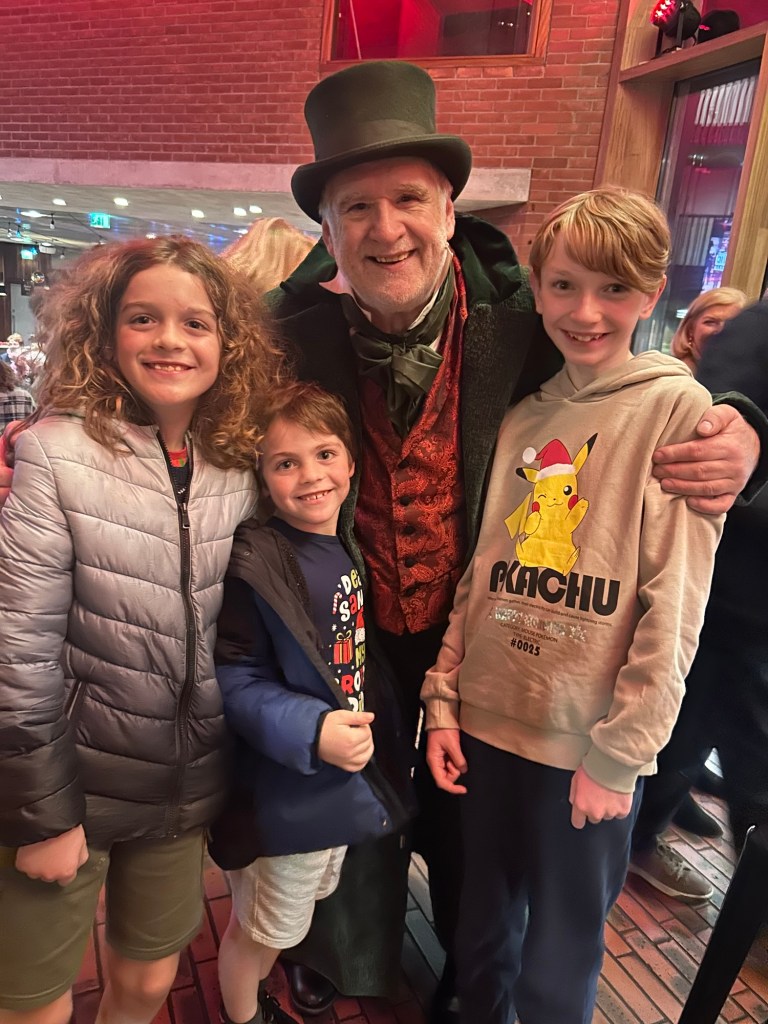
There is one last surprise. As we leave the theatre a smiling Scrooge appears before us. A top-hatted Gordon is there in the foyer to meet and greet every member of the audience. He doesn’t have to do it, but here he is. No remark is ignored, or handshake refused. There is time for everybody.
My son and nephews, already joyful from the show, cannot believe their luck. It is as if Santa Claus himself has descended the chimney. They rush to him and he happily gives his time and poses for pictures.
The fourth wall has been breached. Perhaps a little bit of the magic of the story has leaked out too. I hope that it takes a deep root within me.
As I prepare to face the cold of the night, I am possessed of a thankful heart.
Merry Christmas to all.
- This article first appeared in the News Letter
 What's a daddy for?