0

The nuisance phone calls

A year ago I switched my electricity supplier. A rival company was offering a deal with cheaper prices, so I moved over.

Then a couple of weeks back my original supplier phoned me to inform that the deal which had lured me away had now expired and their prices were once again cheaper. So I moved back.

Then a couple of days ago I was phoned again by the rival supplier. They had obviously got wind of my intended treachery and wanted to turn my head by reading me long lists of unit prices. I was doing homework with my son at the time, and in truth getting a bit fed up with this, so I told them to call me another time.

Which they have done. Again and again and again. I now recognise the number and avoid answering, fearful that I’ll crumble once again and end up stuck like a ping pong ball being bounced back and forward between these two energy corporations for the rest of my life.

I don’t receive many personal or business phone calls (almost all of my genuine communication is done by message, email, smoke signal or carrier pigeon) so I have a fair idea that when my phone rings it will be an unwanted call and, very often, of dubious origin.

The numbers are usually English, but sometimes from abroad. Often I don’t answer. But this leaves me in a state of uncertainty, that little nagging doubt in the back of my mind. What if it is a genuine useful call? I wouldn’t want to miss that message from the producers of Strictly Come Dancing, checking on my availability for the next series (‘McCambridge didn’t answer, see if you can get The Krankees instead’).

If I do answer the caller invariably cannot pronounce my name (‘Is that Mr McCaaaambreeedge?’).

They often start by asking me to confirm a personal detail, which I refuse to do.

Sometimes they start by telling me that they have reason to believe I’m eligible for PPI compensation, a dishonest way of making me think they have already done some research of my case.

Other times they ask me if I’ve been involved in an accident (‘not until this very moment’).

But most of the time I never let the conversation get that far, hanging up before any level of personal connection can be established.

Then they leave it half an hour, and try me again.

I’ve had scam calls from Tunisia, where the caller dials your number but hangs up before you can answer. The idea is that you see the missed call and phone back. If you do, the call will cost you a fortune.

On one occasion a caller asked me what sort of phone I was using. The question wrong-footed me and I had to answer honestly that I wasn’t sure. There was a moment of silence before he called me a ‘dickhead’ and hung up.

Another day I answered more quickly than the caller expected and heard her saying to a colleague ‘Christ, I’m going to need a large drink when this day is finished’ before snapping on her corporate voice as soon as she realised I was on the line.

On a couple of occasions I’ve told the caller to ‘hold the line’, left the phone beside the bed and then gone off to have a bath, just to see how long they’ll hang on for.

The calls seem to come in bands. For a few weeks I’ll receive none at all and then several in a single day. I imagine my number is on a database somewhere and, quite possibly, my photo is pinned to the wall of a sweatshop somewhere, under the heading ‘Soft Touch’.

Recently I’ve noticed occasions where I’ve not answered a call from an unknown landline number, only to receive a call seconds later from a mobile.

I really don’t want to be rude to these callers (it must be a terribly difficult and demoralising way to make a living), but the sheer persistence and inanity of the contacts is bringing out the worst in me. It also puts me on edge every time my phone rings, which is not how I want to be. I know there are some genuine calls out there, but it’s getting evermore difficult to weed them out from all of the rotten ones.

I suppose what I’m trying to say is, for God’s sake, just leave me alone.

0

D is for duh

A note was sent home in my son’s schoolbag today.

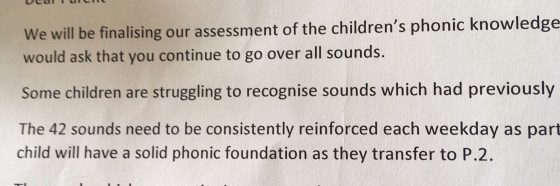
It advised that teachers will be finalising their assessment of the children’s ‘phonic knowledge’ over the next week and asked parents to revise the sounds the kids have been learning throughout the year.

With no little menace one line in the note stated baldly: ‘Some children are struggling to recognise sounds which had previously been identified.’

It went on to advise that the ’42 sounds need to be consistently reinforced each weekday as part of homework’. This will lead them towards having a ‘solid phonic foundation’.

For the uninitiated this may sound like a terribly complicated and woolly business. In reality it’s teaching P1 children to read.

And more specifically it’s about implementing the ‘Jolly Phonics’ system as a method of easing that process.

Phonics is a method of reading where children learn by sounding words out. B is not ‘b’ but rather ‘buh’, L is not ‘l’ but ‘luh’ and so on. There are also accompanying actions, images and songs for each sound. My son has been learning it with mixed results for the past six months or so.

Up to now I’ve avoided passing any comment on phonics for a couple of reasons.

First because I don’t think there is any one universal system which works for all when learning children to read. Phonics may work well for some kids, whole word reading or using memory will be better for others.

The second reason is that I wasn’t entirely sure my wee man was ready for it at the start. He’s young in his class and didn’t seem to get the gist straightaway. Now, as he comes to near the end of P1 he’s maturing quickly and picking up techniques and methods with more success. It seemed fair to wait.

So this afternoon we sat down for a study session ahead of the assessment.

The consonant sounds were fine, he recognised them all without hesitation and was able to give examples of words with each one. He was even able to identify most of the vowel sounds successfully.

It was when we moved on to the single sounds which use double vowels that things started to get tricky. For him and me. Ai was tricky, as was ie and ou. Luckily I had downloaded the Jolly Phonics app onto my phone and had to refer to it several times when I struggled to identify the sounds I was supposed to be teaching him.

At times it seemed like the system had been devised by a sadistic pedant. The logic of trying to explain to a five-year-old that the oo sound in ‘book’ is an entirely different phonic than the oo in ‘too’ was utterly lost on me.

My son tried hard but after a while I could see he was becoming tired and restless. I was struggling also so I decided to call a halt. We’ll have another go tomorrow.

I’m not certain that I’ve managed to ‘consistently reinforce all 42 sounds each weekday’ as dictated by the school’s note, but there you go.

I’m not sure how my son will fare in his assessment. But I’m not too bothered.

He has always loved books and reading, his speech and vocabulary have always been splendid and his imagination works without bounds. I have no doubt whatsoever that he’ll be perfectly literate, with or without the help of Jolly Phonics.

The point that the system seems to be missing, in my opinion at least, is that much of this knowledge about sounds is intuitive. Kids often know things before they can explain what they know. I stopped today because I was getting the strong sense that the only thing I was achieving was confusing my son. Education is so much wider than being able to point out the difference to the ear between er and ar. It’s just too bloody abstract and, at times, without logic.

I’ve worked as a writer all of my adult life. I also do occasional public speaking. I’ve even learnt a form of written communication which is entirely based on phonics – it’s called shorthand.

But, in truth, I struggle to find a clear path between good written or verbal communication and the system they are being taught. The process is immediately undermined by the lists of words which are sent home in my boy’s schoolbag every week to be memorised. We are told they are special cases which are to be learnt by sight and not by sounding.

I don’t want to be overly critical because, as I said earlier, I’ve no doubt that phonics has its place as an aid to literacy, just as learning by context, meaning and illustration do as well. But the curriculum currently favours phonics. The debate over the best way to do this has been going on for decades and will continue for many more.

In the meantime my wife and I will continue to cuddle up with our son and a book in bed every evening, we’ll point at the words and he’ll tell us what they are. I don’t know about his solid phonic foundation, but along the way he’ll certainly learn to read.

0

Neville ‘F**k the Irish’ Sanders and me

As a former journalist I sometimes get asked ‘what’s the best story you’ve ever worked on?’

Two decades of employment in newspapers here meant I had the opportunity to be report on many of the most important moments in our recent history – historic political developments, terrorist outrages, sporting triumphs and failures.

I was also privileged to meet a more diverse range of people than I would otherwise have expected and to witness sights that will always stay with me (watching Air Force One roll along the tarmac of the runway at RAF Aldergrove as George W Bush arrived for his ‘Iraq War summit’ with Tony Blair at Hillsborough is one such example).

But when I get asked the question about my best story I always reply ‘Neville Sanders’.

Which almost always brings the response ‘Who’s that?’

Which takes me back to 2003 when I was a fresh-faced and ambitious young reporter with the Belfast Telegraph. I was determined to make my name in journalism and constantly sought out my own stories, networking a wide range of contacts prepared to feed me information.

I remember very clearly I was at a murder scene in the spring of that year when I got a call from one of these contacts wanting to share some information.

The information turned out to be a letter written by Carrickfergus council to Peterborough council. It was a circular letter sent to all councils throughout the UK requesting support for a campaign to launch an inquiry into the death of private Paul Cochrane, a young soldier who shot himself at a Royal Irish regiment barracks.

Usually such a missive would receive a formal response, a vague letter in return expressing support or not. It’s the sort of correspondence which runs through all local government on a daily basis.

But on this occasion Carrickfergus council received an unexpected reply. Their own letter was instead returned to them with a hand-written message scrawled onto it. The note read: ‘Members of the armed forces do get killed, be it by accident or design. That is what they are paid for.’ It was signed ‘Neville Sanders’.

I Googled the name. It turned out Neville Sanders was the Conservative leader of the council, a self-made millionaire and colourful, controversial character who seemed to attract friends and enemies in equal measure.

My source told me that Carrickfergus councillors had been outraged by the tone of the response. He also told me that they had decided that the matter should be dealt with privately.

I had a different idea and decided I would call Mr Sanders.

I was at home that afternoon. I phoned Peterborough Town Hall and was told Mr Sanders was not available. I waited half an hour and tried again, this time I got put straight through to his office and was met by a gruff, impatient voice.

I remember being caught unaware, scrambling to find a pen and an empty page on my notebook. I nervously asked him if he thought his language in the correspondence was appropriate. I told him members of Carrick council had been offended by what he had written.

He began his response: ‘I don’t give a fuck what Carrick council thinks.’

And off he went. My hand began to ache as I scribbled shorthand notes at speed. He said he was ‘fed up paying taxes to pay for to pay lazy Irish bastards in Ireland’. He said ‘soldiers had to be prepared to deal with a bullet’. He demanded an apology from the people of Northern Ireland for all of the British servicemen who had been killed here.

He went on: ‘We are quite happy for Northern Ireland to fuck off and run its own affairs. Tell Carrickfergus, wherever it is, that their whole bloody scenario over there has killed a lot of Englishmen. If you do not want to be part of the UK, then fuck off.’

The conversation probably lasted less than ten minutes but the implications of it would stay with me, and Mr Sanders, for years.

I remember I rushed to transcribe my notes, because I wanted to ensure that the record was word perfect. Then I went to bed.

I was in the office early the next morning and wrote up my story ‘Tory councillor’s foul anti-Irish rant’. The editor seemed pleased with it and it appeared on the front page. I was happy that I had produced a front page exclusive and, I suppose, I imagined that would be the end of the matter.

Not a bit of it. The first sense I had that something was a bit different was when I was at my desk reading the first edition. One of the Tele’s then army of sub-editors,a mysterious gang of senior professionals that young reporters showed reverence towards, strolled by, pointed at page one and growled ‘That’s the best story that’s ever appeared in this newspaper’. I flushed deeply.

The phone calls started sometime in the mid-afternoon. BBC, UTV, national papers, all wanting to talk to me about what had happened. Journalists usually try to avoid becoming the story but, in this instance, because the comments had been made directly to me, there was no other way for other media outlets to cover the story other than going through me.

It led all the broadcast news bulletins that evening. Mr Sanders made multiple TV and radio appearances, and while he had naturally toned down some of the more profane nature of his language, he was still bullish and not in the mood to back down. At no point did he deny any of the comments he had made to me.

Later the anchor on BBC Radio Ulster’s Evening Extra won an award for her interview with Mr Sanders. The judges said she had demonstrated she was ‘not afraid’ to ask the politician the difficult questions (not that I’m bitter).

The story turned out not to be a one-day wonder. Instead anger grew over several days and the pressure on the local politician began to snowball.

Perhaps sensing he was in trouble Mr Sanders then changed tactics and began to backtrack. After a short period claiming he was misquoted, he then conceded that he had made the remarks but insisted I had provoked him. The Tele received a solicitor’s letter claiming I had phoned him more than twenty times and alleging that I had continually barracked and abused him with anti-English comments, until I got the response I was looking for.

I had to produce my personal phone records to nail this definitively as a lie.

By now the story was being pursued by every news organisation in the UK. Private Eye jumped on it gleefully, labelling the previously obscure politician as Neville ‘Fuck the Irish’ Sanders.

I got to know the family of Paul Cochrane, the young soldier who had taken his own life, and whose case had sparked the original correspondence. They asked me to go to England to confront Mr Sanders. I agreed.

By now his career was in desperate trouble. He was facing investigations from the Standards Board, which examines the standards of local politicians, and from within his own party. A motion of no-confidence in his leadership of Peterborough council was introduced and his own Tory group divided into those who would support him and those who were ashamed by what he had said.

I went to Peterborough to cover the council motion and to meet Mr Sanders. I remember the very surreal experience of three TV camera crews being there to film me as I got off the train.

When it became clear that Mr Sanders would lose the vote he decided not to attend the council meeting. I went along anyway and presented a letter from Paul Cochrane’s parents to the council chief executive, asking her to pass it on.

I remember being struck by the strength of feeling, both in favour and against Mr Sanders. I met people who were outraged by him, but also others who said he had done more for the town where he lived than I would ever understand.

One tiny elderly female Tory councillor was so angry that she barracked me for several minutes outside the chamber. Shouting into my face that I was orchestrating a ‘Sinn Fein plot’ to discredit the armed services.

Two large Tory councillors actually stood at the doorway to the council chamber to block my entrance at one point. The whole episode was being filmed and after I tried to make a light-hearted remark, they eventually stood aside.

Tensions were running high. When the vote was cast Mr Sanders lost and was deposed as council leader.

It was only later in the evening I realised that I had nowhere to stay in the city. I went to a bar, befriended the landlord, and ended up sleeping on his son’s bunk-bed that night. I was awake early the next morning, still severely inebriated and on a packed commuter train back to the airport, trying to file my copy for that night’s Tele over the phone.

That really should have been the end of the matter, but it refused to go away. The Standards Board held an investigation and banned Mr Sanders from being a councillor for two years. He was later also thrown out of the Conservative Party.

But he refused to go quietly and launched legal action, taking the matter to the High Court. He managed to get the severity of his punishment reduced to a prohibition on leading the council for 12 months.

I was asked to take part in several investigations and, while I did my best to co-operate, I avoided too much active participation. In my view the story was done and finished and it wasn’t my role to decide on the punishment. Also, in truth, I had become tired of it, I wanted to move on and leave it behind, to move on to new stories and challenges. But it refused to leave me alone.

There was one humorous moment where I was asked to provide my notes for the High Court. I duly complied. Then I was contacted by a court clerk who asked me to translate them. It seemed there was nobody in England who used the old Pitmans 2000 shorthand system which I had been taught at journalism school.

In 2005 Mr Sanders went on the offensive after his punishment was reduced, claiming publicly that his reputation had been entirely vindicated. The court had decided that there were defects in the way the Standards Board tribunal had dealt with his case, but he instead choose to represent it as defects in the original story I had written.

I was moved to phone him once again and we fenced with each other once more. He insisted his interpretation of the outcome was correct. When I tried to question him he kept repeating ‘but the court awarded me costs’ over and over.

This led to a renewed flurry of interest in the story. The Nolan Show picked up on it asked me if I was prepared to debate the issue live on air with Mr Sanders. I wasn’t hugely enthusiastic, but it seemed a better option than simply allowing him to rubbish my reputation.

The next day I waited beside the phone. Then a Nolan producer contacted me and said Mr Sanders had decided not to participate. I didn’t admit it but I was relieved. It was time to let it lie.

The following year Mr Sanders lost his council seat and his political career was finally over.

Neville Sanders died in August 2016, with his reputation never having fully recovered from his short interview with me in 2003. I imagine that he would have been completely unrepentant to the end.

Reports on his death in local media reflect on his huge energy and enthusiasm as a businessman and councillor, and his spirited efforts to improve his own city. He paid out of his own pocket to keep Peterborough’s Lido open in 1991 and 1992 and was once arrested when trying to help a local couple find 50p to put in a parking meter. In 1990 he was bound over to keep the peace after a charge that he had punched another councillor was dropped

I learnt a lot about the nature of journalism and politics from him. And just as much about the volatility of human nature.
1

Getting in a flapjack

I’m making flapjacks this afternoon. As baking goes it’s pretty low maintenance.

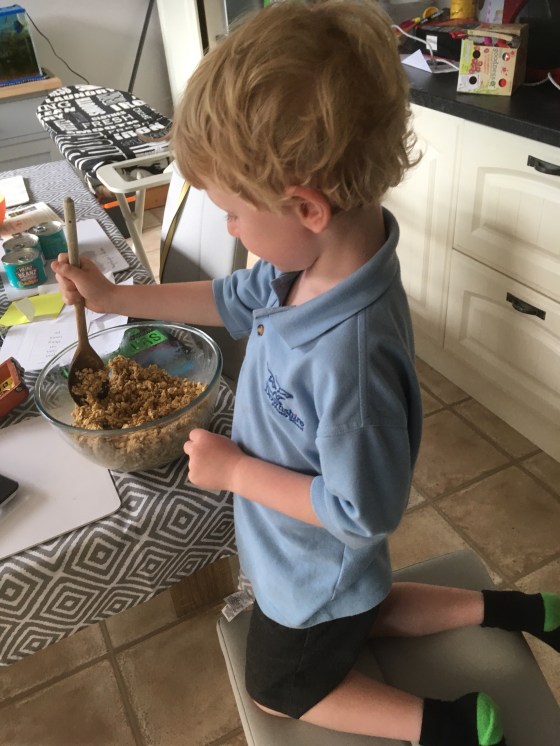
So I decide to get my son involved. He’s always nagging me to let him help out in the kitchen.

But I decide today’s the day when I’ll really let him help. Not just get him to pose for a picture with the wooden spoon and then send him off to watch Danger Mouse; but to truly get his hands messy.

Which is a challenge for me. The kitchen is my zone and in it I do things my way. I don’t accept help in there easily and family and friends know not to offer.

The last time I let my son loose in the kitchen he looked over the side of the mixing bowl into my chocolate cake mixture. My anxiety levels soared.

With a mischievous smile he asked if he could try a bit.

I reluctantly agreed.

Then he sneezed directly into the bowl, rendering all the contents unusable.

Today we start with me trying to explain how the scales work and allowing him to measure out the oats and butter. It’s messy and some oats spill on the floor, but nothing too traumatic.

Mixing is a different matter. Great dollops of the oaty mess spill over the sides of the bowl like waves crashing over the top of a sea defence wall.

He enjoys adding the golden syrup. Unfortunately when I tell him ‘enough’ he keeps squeezing the jar as he moves away from the bowl, leaving a sticky trail behind him like a slug.

I can feel the vein behind my left eye begin to twitch, but I force myself to keep encouraging him and praising him.

Placing the gooey mixture into the baking tray is a partial success, in that some actually goes in.

The end result which emerges from the oven is surprisingly successful, if a touch unstable because of the over-exuberant addition of too much syrup. It falls apart when we try to eat it but my son is too flushed with the success of his achievement to notice or mind.

The floor is a different matter, although in fairness the butter between my toes works as a useful magnet for attracting all the rogue oats and sugar granules.

He wants to bake something else but I gently advise him that it would be difficult to top the flapjacks. We’ll leave it for another day.

In truth I had to work very hard to let him do it without taking control myself. To let him make his own mistakes.

It occurs that me that doing kiddie things with him comes a lot easier than him doing grown-up things with me.

He enjoyed his baking experience today and will be a little bit better next time. But he’ll always do it his way, not my way.

He learnt a little bit about doing it for himself.

More importantly I learnt a little bit about letting him.

1

Miserable Monday morning

I go to bed late but I still can’t sleep. It’s too warm and I keep turning over, throwing the covers off me and trembling each time I hear a noise through the open window.

I’m up several times during the night. It never seems to get properly dark during June.

As I lie there, afraid and praying for sleep, I think about the usual things – work, money, my family. I think about the weekend just past, the glorious sunshine and the wonderful solace of being with family.

I suppose I must have eventually dropped off because the alarm terrifies and confuses me with it’s hideous metallic horn. I sit upright quickly, every sinew of my body and their connecting messages with my brain calling out desperately for more rest.

I get up quickly. I know from past experience this is best. Then I stumble downstairs holding the bannister for comfort, still somewhere between awake and asleep.

I contemplate breakfast but decide I can’t face it today. Instead I iron my son’s school uniform and stand under a tepid shower, allowing the spray to bounce off my skull, hoping it will replenish some energy.

I kiss my sleeping wife and son goodbye. The joy of the weekend just past making the separation now a little more bitter.

I drive automatically along the motorway towards the city, changing the station on the wireless several times until I give up and snap the dial off. I prefer the silence now anyway.

I park in my usual spot and walk along the road, where shops and offices are opening and people are reluctantly dragging themselves to face the new week.

I’m still not quite alert, my brain feels like wet sand and the muscles in my arms and legs scream out in protest over my insistence on moving around. My stomach is unsettled, I know I’m hungry but unable to face food.

Despite my lethargy I find myself noticing lots of detail. Two empty, crushed Guinness cans on the pavement beside the bus shelter. The arm protruding from the sleeping bag in the doorway of the church. The crow dragging the empty plastic bottle, larger than its body, across the spring grass.

I stop at the coffee shop, my usual buffer before work. The friendly Eastern European woman knows my order without having to ask and reminds me to produce my loyalty card.

‘Just two more and you get one for free’, she tells me.

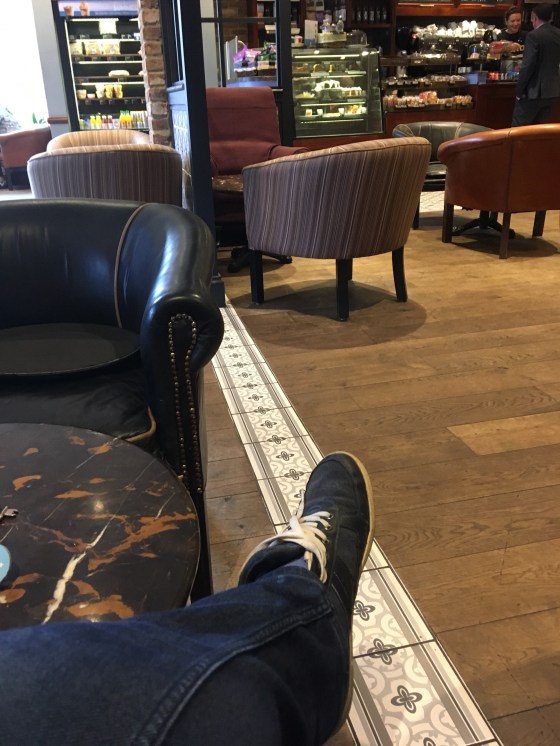
I go to my usual seat and study the faces, some are regulars, some new. There’s the guy in the tweed jacket with his laptop, who I’ve long ago decided is an academic. The woman who wears the black sandals who has a different book everyday. The older woman who ties her dog to the railings outside and then picks the window seat with a clear view of it.

I check the time on my watch, working out how many minutes I’ve got before I go to work. Then I begin to count them down.

My coffee is cool enough to drink now and I start to sip at the bitter, black liquid, hoping it can restore something in me.

The weekend has never seemed further away. It’s a miserable Monday morning.