We are walking out of my son’s primary school for the last time at the end of his final day in P7. There is no doubt that this emotional event will be the subject of my next column (that’s just what I do, right?)
We are smartly dressed as we are due to travel on to a farewell class party which has been organised for children and parents. I drive the car onto the road but am immediately aware that something is wrong. I pull to a stop again beside the pavement.
I get out and discover that the rear left tyre is completely flat. I stare sadly at the rubber rim which is sinking uselessly under the weight of the car, like Atlas with lumbago.
‘Oh boy’, I mumble to myself, as scenarios, difficulties and challenges multiply in my mind.
I have suffered punctures with vehicles before. I have successfully changed a tyre in the past. But not in a long time, perhaps more than 20 years. I have a vague recollection of the method and the technique. I am reasonably confident that if I was home in the driveway, I’d be able to complete the job. But here, at the side of the road, with pedestrians and cars going past, my brain becomes scrambled and I’m not so sure. It’s a bit like peeing in a urinal, I know I can do it, but not with people watching.
If I were to prove unequal to the task I think of alternative approaches. I could phone my da for help. Having said that, I’m pushing 50 and there has to be a statute of limitations on such things. The other possibility is to summon the RAC as I’m a fully paid up member. However, there seems to be something emasculating about having to call for help. I decide I will attempt to proceed alone.
I start to make a mental list of the equipment required and steps to be undertaken. I go to the boot to begin the search for the spare tyre. This first of all requires emptying seven years of junk from the space. Video gear, tripods, umbrellas, walking boots, two pairs of my wife’s shoes and countless shopping bags are piled at the side of the road before I locate the base which is lifted to reveal the spare tyre underneath. It seems to be resting in a small pool of rusty water, which I take not to be a good sign.
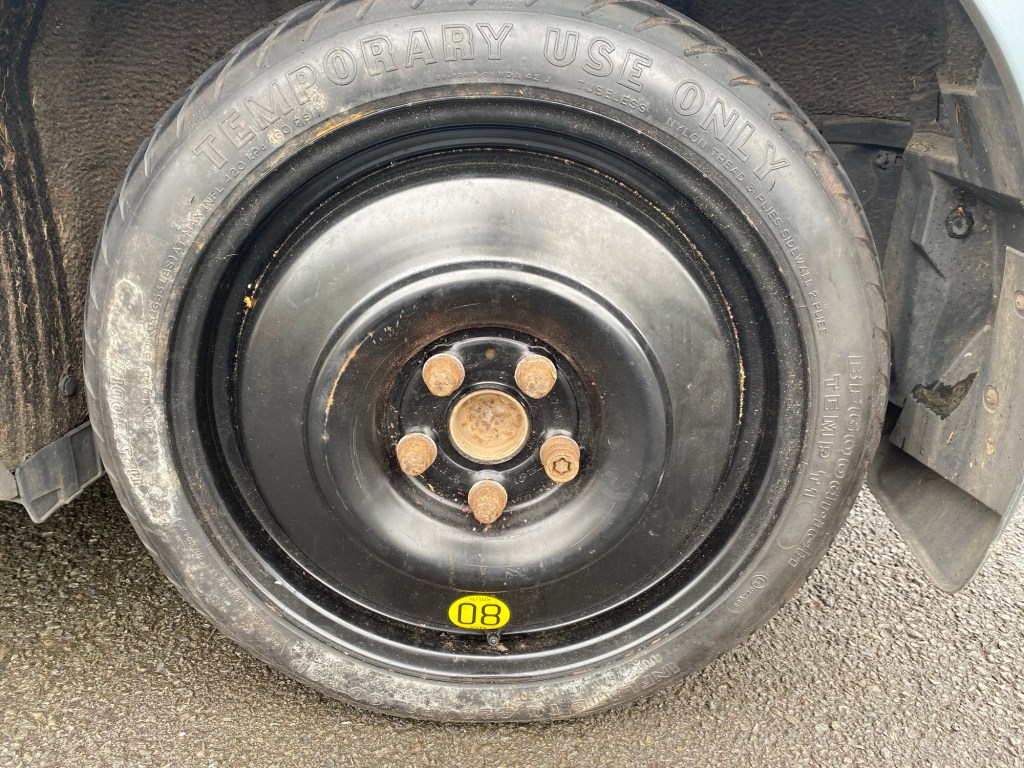
I struggle to move the spare tyre. I notice it is not substantive, not a like for like replacement, but a temporary emergency wheel, a ‘get you home’ tyre which looks more suited to a moped than a car. I can almost hear the disapproving tuts of my da at the sight of the flimsy article.
I have found the tyre, but the jack is not with it. This disturbs me as it seems logical that they should be together. I begin to search the car for the implement, looking under the back seat for hidden compartments as if it were a magician’s cabinet. The jack is eventually located after a panel is removed from the side wall of the boot. It takes me another 10 minutes to work out how to remove the tool from the slot in which it is neatly and tightly encased.
While I am trying to solve this conundrum there is a significant development. A family that we know approaches. It is my son’s best friend from school. Through this relationship, my wife and I have also become friends with his parents.
There are multiple benefits. My son, who is becoming agitated and bored, now has someone to play with. My wife has someone to talk to. Best of all, there is now another grown-up male on the scene. This man is larger than me, louder than me and, to be frank, sports a more impressive beard.
His opening gambit is to state that he doesn’t want to insult me by offering to help in changing the tyre. However, something in my pathetic wrestling with the jack must persuade him that I would very much welcome any such insult and he quickly sets himself to loosening the wheel nuts.
I have eventually freed the jack and I’m close to spent already. I put it in place under the car but struggle to get the handle to turn easily. My friend takes over and proves to be much more proficient. The vehicle is soon elevated and I’m able to fully remove the wheel nuts.
But the biggest obstacle now presents itself. The wheel should slide off. It does not. Instead it gives every indication of being stuck fast, as if it has been rusted onto the car axle. I try feebly to remove it. My friend tries more robustly. It does not shift. He asks me if I have a hammer. I do not. I strike it a few ineffective blows with the handle of the jack. Then my friend, in his smart clothes, positions himself on the dirty ground inside the tyre and lands a hefty kick with his giant boot which frees the wheel, launching it outwards like a piece of freshly popped corn. I can do nothing more than nod appreciatively.
From here, the task is more straightforward. The replacement tyre is fitted, the jack lowered, and the bolts tightened. My friend has thoughtfully brought wipes which allows us to clean the worst of the smears of black grease from our hands.
As we say our goodbyes, he charitably tells me that it was a ‘two-man job’. Of course, it depends who the two men are.
Before I drive off, I make a final check on the flimsy replacement tyre. There is a message on it advising not to drive faster than 80kph while it is fitted. I am not happy with the temporary remedy and tell myself that I must get to the garage urgently so the proper tyre can be repaired and restored.
I am sitting uncomfortably in a worryingly small seat at a disturbingly advanced height peering at a dimly lit stage far off in the distance below.
I am also giggling nervously for a number of reasons. I lean across my son in the direction of my wife who is sitting at the end of the row.
‘The woman on the way in said this show lasts for five hours?’
‘Yes, I told you that several times. It’s divided into two parts with a break in the middle, but five hours in total.’
I sit back in my tiny seat in the famous old theatre. We are in London on a short family break going to see a West End show. A Harry Potter West End show. We had promised our son this treat months ago, and countless excited words have been spoken about it since then. But it is only now, amid the hustle and whispers of the pre-show enthusiasm, that the full implications are beginning to dawn on me.
Our seats are very far from the stage, being the best that we could afford without having to re-mortgage the house. As we arrived at our place high in the balcony, I was disturbed by how steep the stairs and rows of seats were, as if the theatre had been squeezed and compressed by a pair of giant hands. The slope is so sheer that I have a genuine concern that, if as expected, I doze off during the show, I might keel forward and cause an incident by rolling down the rows and then falling onto the stage below.
The stage seems to be so far away. I look at my son beside me, peering excitedly through a tiny pair of binoculars.
‘Can you see ok son?’
‘Yeah, these are the best seats. I can see everything.’
Another problem is space. The theatre is full for the first part of the double performance. I have absolutely no leg room. I guess that the building was constructed in an age when people were shorter. My knees are already digging painfully into the hard, shining wood of the seat directly in front and I can’t seem to reposition myself for comfort. I am also sweating profusely in the heat and beginning to panic a little. Waves of claustrophobia roll over me. I can’t sit in this stationary position for five hours. I fear that I will crack. I lean back towards my wife.
‘Do you mind swapping seats? I can’t move my legs here, there’s no room.’
This turns out to be a major hassle in the tightly packed theatre which involves several people having to stand up, readjust their position or lift items from the floor in order that I can be re-seated. I hear several tuts of disapproval from the row behind as I struggle in the darkness.
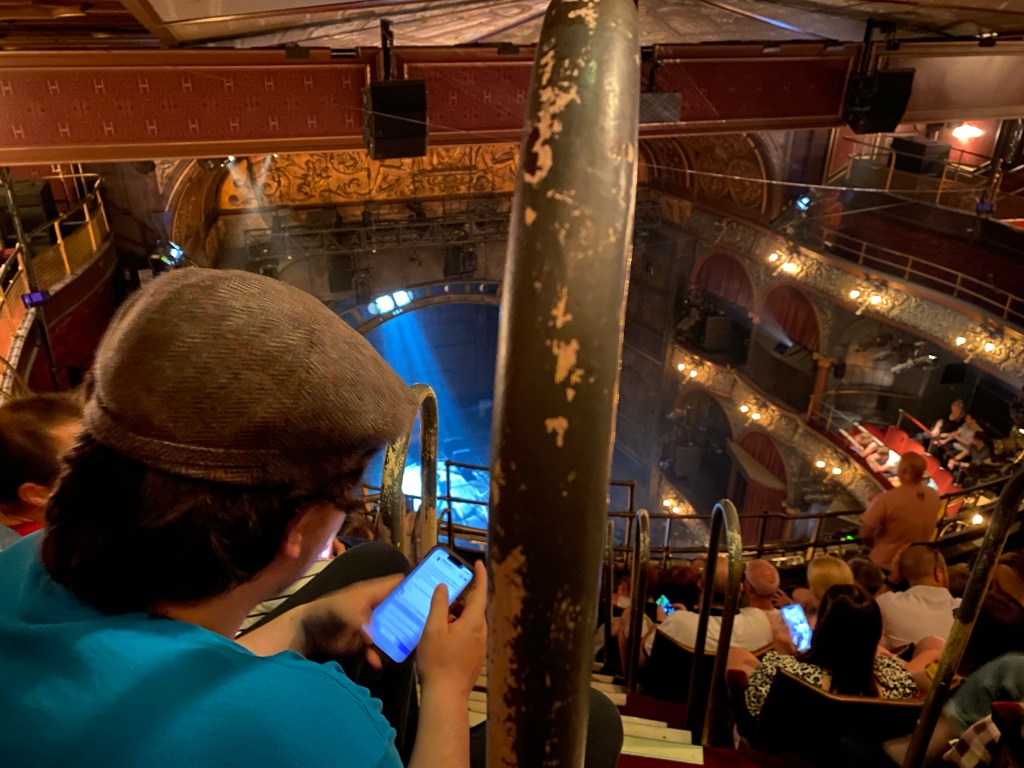
Now, I am sitting at the end of the row and can mercifully stretch my long legs out onto the aisle stairs. I inhale and exhale deeply in an attempt to slow down my breathing. However, the new seating arrangement brings a fresh challenge. There is a large and prominent circular metal pole (a safety barrier I presume) directly in front of me now. I try to put my legs to the left of it, but they don’t quite fit. I try to put my legs to the right of it, but this is an unnatural and painful position. The only moderately comfortable solution is for me to sit with one leg either side of the metal barrier so that it rises right in front of my torso and face. This solution, as you can imagine, does not assist an unhindered view of the play.
Then there is the man in front of me. He just won’t sit still. When he leans left, I lean right to try to see the stage. When he leans right, I lean left. And, bafflingly, he is wearing a hat. I cannot underestimate how warm it is in this theatre. There is only one person who thinks it is sensible to wear a hat in these conditions – and he is sitting in front of me. Granted, it is a flat cap, but it begins to divert so much of my attention that he might as well be wearing a top hat.
Finally, the performance begins. My son almost leaps off his seat with excitement and gasps audibly when the actors appear. I sit back and close my eyes for a moment. I think about how this whole short trip has been dominated by my son’s current obsession with Harry Potter.
There was the Harry Potter walking trip where we spent two and a half hours dandering along narrow streets while our guide pointed out corners of buildings which had appeared for a millisecond in one of the many films.
Then there was the visit to the Harry Potter shop where my son buzzed about excitedly while I browsed through some the books. The Harry Potter Vegan Cookbook. The Harry Potter Book of Knitting Patterns.
At one point in the shop, I waited while my wife and son queued at the till. I smiled at a man of roughly my age who was standing close by.
‘Do your kids love Harry Potter too then?’
He stared hard at me.
‘I don’t have kids.’
And now, here I am sitting with my eyes closed in the dark theatre, with a huge metal bar in front of my face. There are five hours of Harry Potter ahead of me.
My son’s small hand slips inside mine. I can feel the slight tremble of excitement. I open my eyes and glance quickly at him, utterly transfixed by the action on the stage.
I sit back and try to relax. I hear the music, watch the movements and expressions of the actors, pick up the thread of the story. I begin to reacquaint myself with the long-forgotten joy of live theatre.
I have always thought you can tell a lot about a person’s character through their approach to Easter eggs.
It is my considered view that, in broad terms, society can be divided into two groups – those who eat their Easter eggs, and those who keep their Easter eggs. It might not be a surprise to discover that I fall definitively into the former category.
Let’s go back to the beginning. Aside from the religious significance of Easter, for a young boy growing up in Northern Ireland in the 1970s or 80s, this holiday was pretty much all about the chocolate.
I am aware that there are other egg-themed activities that apparently exist – some people paint eggs, some families roll eggs, some individuals hide eggs and then encourage children to find them.
To be completely clear, I did none of these things, nor did I ever meet another child of my generation who did. Our Easter tradition, simple and direct as it was, consisted of being given lots of foil-wrapped chocolate eggs encased in colourful cardboard boxes, and then eating them (the eggs, not the boxes).
The Easter Bunny was not, to the best of my knowledge, a popular concept in north Antrim either. There was no Santa-esque pretence of rewarding children who were good or obedient with a present from the folkloric rabbit. Your family bought you Easter eggs. That was how it worked.
There was also a raffle in primary school at Easter time. Eggs of various sizes were offered as prizes. The top prize was always a monster-size chocolate egg resting in a basket and surrounded with straw. This scale and style of confectionary, to someone from my sheltered background, seemed impossibly exotic.
The problem was that I never won anything. It might not be an exaggeration to state that much of my pessimistic outlook on life and the world around me was shaped by my consistent lack of success in the Easter raffle. Year after year I got my hopes up. There were multiple prizes and only so many boys in the school. I had usually bought a few tickets. Surely, my name would eventually be drawn. It never happened.
In P7 I decided that I was going to be proactive about changing my luck. I spent all of my pocket money over several weeks on tickets. I scraped together every penny that I could find to ensure that there were more tickets in the hat with my name on them than any other boy in the school. I might not win the monster egg, but I was determined that I was going to win something.
The boys gathered, chattering excitedly, in the school dining hall for the raffle. A dizzying selection of chocolate eggs of varying weight and circumference were displayed proudly on a table on the little stage. The draw was made. I won a Cadbury’s Creme Egg.
Let’s move on from those obvious mental scars and consider the ritual of waking up on Easter Sunday. The egg from my parents would be ripped open and devoured well before 9am. We would then visit relatives where a haul of perhaps another half dozen eggs would be gathered. By the end of Easter Sunday more than half of these would be gone. After that, there was no expectation or possibility that any chocolate eggs would be left beyond Easter Monday.
But this was not the way it was for all children. I had some friends who liked to keep their Easter eggs to ‘make them last’. This practice consisted of opening the confectionary and breaking off a small square. Several hours later they might return for another meagre portion. Considering it was usual for a child to receive multiple eggs, this approach could lead to the treats being stretched out over several weeks.
To be clear, I am not advocating my approach as superior to the other. My habit was clearly not sensible and can be characterised as a series of incidents where I would make myself sick on chocolate, wait until the effects had worn off, and then go and make myself sick all over again.
It was simply that I could not understand the temperament, character, personality or restraint of those who had access to chocolate but were able to follow the path of temperance. These people, while of the same species as me, were clearly driven by different forces.
Such was my desperation for chocolate that once I had finished my eggs, I would very quickly move on to those of people around me given the chance. I remember visiting a cousin who proudly liked to display her undisturbed Easter eggs in their boxes. While she was out of the room, I carefully opened the packaging of one egg, removed a substantial chunk and then replaced the foil and the box so that my theft would not be immediately discovered.
Now, as a parent, my supposed role is that of buying rather than eating the Easter eggs. The problem is that my infatuation with sugar has barely dimmed over the years.
Moreover, my son falls firmly into the category of liking to make his eggs last. He certainly enjoys chocolate, but he will consume a sensible amount and is prepared to wait until he asks for more. In fact, he often seems to take as much pleasure from looking at his collection of eggs in their grand boxes as he does from eating them.
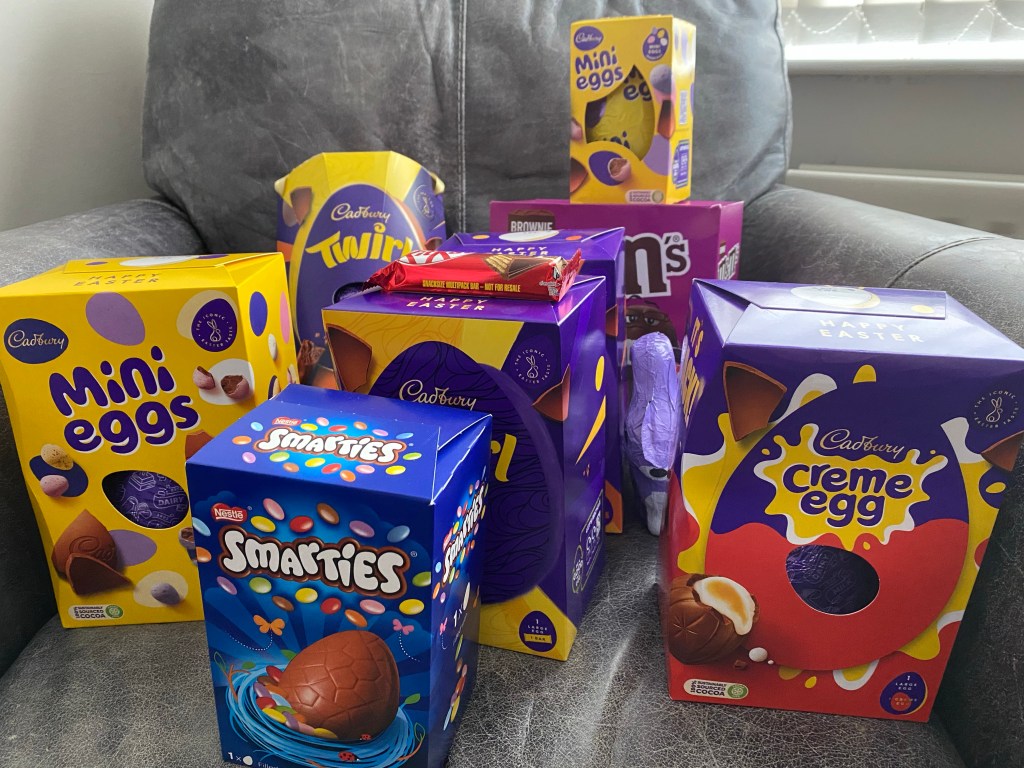
Which brings me at last to the point (yes, there is one). As I write these words there are, not six feet away from me, six Easter eggs on the kitchen counter. They all belong to my son.
In the scale of parental sins, I am not sure where eating your child’s Easter eggs ranks, but it must be pretty high. I am doing everything that I can to resist, but the chocolate is calling for me. Surely he won’t mind if I just have a little nibble…..
According to the website of the World Health Organisation, the SARS-CoV-2 outbreak was declared a global pandemic on March 11, 2020, just months after the virus was first discovered in Wuhan, China.
As I remember from the beginning, we all referred to it as the coronavirus until the WHO gave it the name Covid-19, which quickly passed into common usage.
What happened next is carved deep enough into our collective memories that it needs no repetition here. Like most others I hunkered down with my family, attempted to obey often fluid and confusing social distancing rules, and waited for my turn to become infected, as it seemed I inevitably would. I recall thinking that when I contracted the virus, I would write about it in this column as a means of helping to raise awareness of the effects.
I remember keenly that early anxiety over the spread of Covid, as it seemed to be inching geographically closer. First there were rumours that someone I knew had it, then a friend on WhatsApp was infected and recovering at home in bed, then several friends, kids at my son’s school, extended family and finally close family.
Covid arrived at our house in December 2021, just in time to wipe out all our plans for that Christmas. My son was infected first. I got the news of his positive test while I was in the car on the M1 driving to a job where I was to interview then First and deputy First Ministers Paul Givan and Michelle O’Neill. My participation in the job was quickly abandoned as I had to drive straight home to begin isolation. A few days later my wife tested positive also.
But the strange thing was that the virus somehow refused to settle on me. The opportunities were clearly there. My son, while infected and bored at being unable to leave the house, was my constant companion. During those long days of social isolation, he hugged me, jumped on me, climbed on my head and often sneezed over me. Still, I avoided infection.
I lost count of the number of times I was tested by having swabs stuffed up my nose until they made my eyes water. The results always came back negative. There was the drive-through testing centre which we had to visit every time someone in my son’s class became infected. There was the large walk-in testing centre which was erected in a car park in Lisburn where I was on first name terms with some of the staff.
When I was travelling to the US with work, I needed a negative test on the morning I was due to fly before I was allowed to check-in. When I was holidaying on a cruise ship, I required a recent negative test result to be displayed on my phone before I was permitted to board the walkway which took me towards the giant liner.
As the pandemic progressed, I went through boxes and boxes of home testing kits, following the instructions carefully and putting four drops of solution into the little white plastic box. It was always negative – one line rather than two.
It got to the point where I think that almost everybody I knew had contracted Covid at some point over the last three years – except for me. It wasn’t clear whether this was caused by judicious caution on my part, sheer luck or simply the fact that I don’t have many friends. I had certainly been exposed to the virus, was there some hidden reason why I had not become infected?
I began to read about people who seemed to be naturally resistant. Scientists were seeking them out so they could study those who appeared to be genetically immune to Covid, in the belief that they may hold the secret to keeping the rest of the population safe from future pandemics.
I started to wonder if I fitted into this group and whether I should come forward and volunteer myself as a member of the resistance? Should I allow samples of my blood to be taken, stored and experimented on for the good of all mankind? It seemed a weighty responsibility.
Last week I was tired. This in itself was not remarkable, I am always tired. I have been tired for all of my adult life. It can be difficult to distinguish between an exhaustion which signifies something might be wrong and my general state of being.
But this fatigue seemed to be particularly acute. My limbs were heavy and felt as if they had been stuffed with straw, like a scarecrow. When I awoke it seemed to be an almost insurmountable effort just to haul myself upright.
I told my wife. She immediately suggested that I test myself for Covid. This surprised me because, like most others, the virus, had now been put to the back of my mind. Moreover, the stock of free home testing kits given to us during the worst of the pandemic were gone. I hadn’t expected to need more.
My wife went to the chemist and bought a box of tests. I, once more, went through the process of sticking the little swab up my nose. Once more it was negative – one line rather than two. I shrugged my shoulders and went to bed to try to restore energy.
The next morning I felt worse, the hours of sleep succeeding only in deepening the wretched exhaustion. In addition, I could now feel the onset of unpleasant flu-like symptoms. My throat felt as if an intruder had two hands around it and was consistently applying more pressure. My wife exhorted me to do another test, I argued that there was no point as it was always negative. She persisted and I relented.
I did the test again. This time, very clearly there were two lines. Now it was my turn to insist upon another test. My schedule was busy, and I simply felt that I couldn’t afford to get the virus. The second test, and then a third, relayed positive results – two lines rather than one.
At my wife’s insistence I went back to bed. I looked up the date the pandemic was declared. Almost three year ago. After 1085 days, Covid-19 has finally caught up with me.
It is Friday evening and I am lounging comfortably on the sofa. My son is asleep and the bitter memories of the working week are already beginning to drift away towards a hazy, distant horizon. My wife and I are settling down to watch a film on the telly.
There is a period thriller starring Christian Bale which we have been promising each other we would watch for some time, and now, with no need for an early start the next morning, seems to be the perfect opportunity.
However, it quickly becomes clear we have made a slight miscalculation. The film is rather more challenging than I had anticipated. It is a murder mystery with multiple plot twists and diversions thrown up to send the viewer off in the wrong direction. The plot is heavy and complicated and a couple of times I have to stop and rewind, just to ensure that I am properly following each development. It is harder work than I had imagined for lazy weekend viewing.
However, in film, as in everything else, the more you put into it, the greater the reward. I have invested my energy and what passes for my intellectual rigour into this. I have become engrossed in the story and, as the suspense builds, I am expecting a satisfying conclusion followed by the chat when I will tell my wife that I had it all figured out from the very beginning.
I refill the wine glasses as the tale starts to near its conclusion, mentally recapping on what I know, what I think I know, and a plausible list of possible offenders about to be unmasked. I sit up straight as the pace quickens towards its dramatic conclusion. And then….
And then I fall asleep.
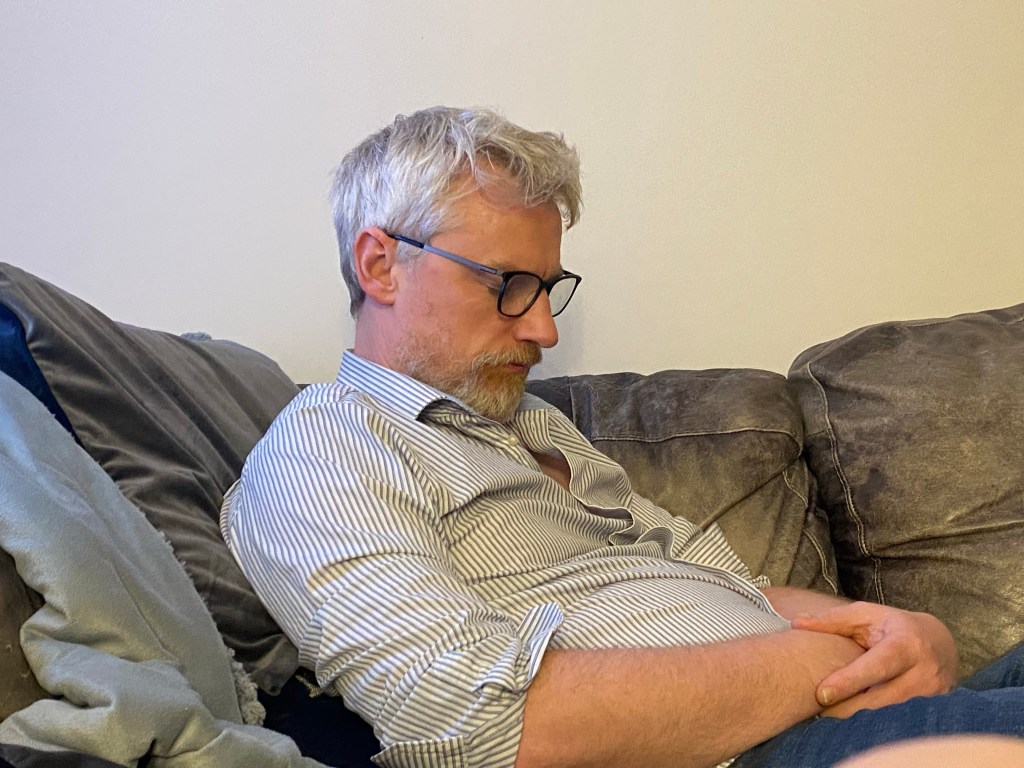
I wake up some time later, still sitting upright on the sofa but with saliva drooling down my chin. My wife is now watching an entirely different programme.
‘What…what happened?’ I splutter. ‘What about the film?’
‘Oh, that finished about an hour ago.’
‘But, but, but…why didn’t you wake me?’
‘You looked so peaceful it seemed a shame to disturb you.’
I make some terse inquiries about how the movie ended before I retire to bed upstairs.
The anecdote described here reveals a concern over the inevitably creeping presence of a new and unwanted sign of ageing – the inability to stay awake when I want to.
This is a phenomenon I have been aware of from youth when I used to witness my dad falling asleep while sitting in his chair. It was simply impossible for him to watch any TV programme for a protracted period of time without dozing off. After a few minutes his head would begin to nod forward slowly like an obedient dog and his eyes would gradually close. Occasionally he would sit upright with a start, waking suddenly, but it was a temporary reprieve. Once the process of dozing off had begun there was no going back.
I used to watch this fascinated as a child. I simply could not comprehend how it was possible to fall asleep while sitting in a vertical position. It seemed to me as difficult a task to achieve as playing a Beethoven piano sonata while wearing oven gloves. No matter how tired I became, how often I would yawn, I could sit up for as long as I wanted without succumbing to sleep.
When I did sleep it had to be in bed, and even that often proved be a challenge. My relationship with rest was always complicated and troubled and I suffered at various points in my life from crippling bouts of insomnia. Occasionally, doctors have prescribed medication to help me sleep, but it never seemed to make much difference. Countless hours of my life have been spent fretting and catastrophising lying awake in the darkest part of the night while those around me slept soundly.
And now, compounding the issue of not being able to sleep when I want to, is the new difficulty of being unable to stop myself sleeping when I don’t want to.
My routine of late-night TV viewing has already been significantly curtailed through my inability to get through an hour of screen time before my head starts to drop.
Reading is even more difficult. Previously, I would have devoured several books a month. Now, I am struggling to make it through several pages a month. I simply cannot stay awake for enough time to gain any momentum in a novel.
I am a member of a WhatsApp group which includes a few friends with a shared love of reading. This is one conversation from last week.
Friend: What are you reading now Jonny?
Me: Mythos by Stephen Fry. I started it in October.
Friend: Oh, is it any good?
Me: Too early to say. I’m only 14 pages in.
And the malaise is spreading. A few times I have found myself dropping off when playing with my son. Once we were in the middle of a race in Mario Kart on his Nintendo when he shouted at me for snoozing. On another occasion I dozed off while supposedly supervising him doing his homework. On this occasion he was rather less prompt in waking me.
Last weekend we were sitting on the floor playing a game of chess. At one point I seemed to be in a strong position, only to succumb to a short nap and then wake to discover that I had lost my queen, two knights, a rook, a bishop and three pawns.
I do worry about where it will all end. Will I fall asleep some afternoon during a conversation with my boss? Will I be against a deadline on some major breaking news story only to awake several hours later with my face stuck to the keyboard with saliva?
These are worrying signs. I usually write this column late at night when everyone else in the house has retired. Often, I write it on my laptop while lying in bed. On more than one occasion I have fallen asleep when writing it (perhaps those who read it will emphasise?).
As it stands, I am simply trying to get to the end before I zzzzzzzzzzzzzzzzzzzzzz
I was walking through the thick crowd of mourners at a funeral when I saw on the other side of the road a man who looked uncomfortable wearing a suit. He was nodding in my direction.
The individual made his way through the throng, grabbed my arm and addressed me by name. I was at a disadvantage in that while I was sure I should know who he was, I didn’t immediately recognise him.
I stammered as I tried to cover my foolishness and embarrassment, but my face must have given the game away because the man immediately realised my predicament and seemed delighted by it. He began to laugh. It was the warmth of the mischievous smile which gave it away.
‘Brian’, I said. ‘Brian Hutton’.
That meeting of two journalists last October, was on an occasion of almost unbearable sadness. We were in Creeslough to cover the final funerals for the victims of the terrible explosion which had devastated the tiny Co Donegal village. However, even on that most sombre of days, meeting Brian was enough to bring a chink of warmth into my heart. We had not seen each other for the best part of two decades and quickly agreed to grab a coffee.
I first met Brian Hutton in the early years of this millennium when we were reporters at the Belfast Telegraph newspaper. I had been the youngest male journalist in the Belfast newsroom until Brian, a proud Londonderry man, arrived. Being of a similar age and unmarried, we began to socialise together. I remember that he didn’t know a lot of people in the city and we enjoyed a few evenings laughing over pints in the Duke of York bar.
Brian loved to go for long walks (a pursuit I was happy to join him in) as well as to swim in the sea (in which I was happy not to join him). He also loved to eat and I loved to cook, so I made dinner for him a few times. He seemed completely intrigued when he discovered that I baked my own bread and I remember one evening he watched captivated as I kneaded dough as if it was a practice of some mystical importance. When I made loaves, I would often bake an extra one and then wrap it in tinfoil for Brian.
The passing of time means that most of the details of the time I spent working or socialising with Brian Hutton have faded. What I do remember is the shared laughter and his insatiable desire to absorb all the details of a good story. He would listen intently when you told him a yarn or an anecdote, sucking in the details like they were oxygen.
He was also dedicated to his work. On one evening shift he was sent to cover a riot in the Ardoyne area of Belfast. He must have got too close because he ended up injured and was taken to the emergency department of a local hospital, becoming the subject of the story rather than the author.
I suppose over a period of about a year we became friends. If things had kept going in that direction, we may have become very close friends, but I sensed from early on Brian’s restlessness. He seemed to quickly outgrow Belfast and wanted a new challenge. After little more than a year working alongside me, he left the paper in search of different opportunities. We shared a last few pints before his departure and said all the usual things about staying in touch. I have no doubt that we both meant it.
Brian went to work as a reporter in Dublin. I saw his byline in countless newspapers covering major news events over the ensuing years. Perhaps as some sort of acknowledgement of the time we had spent together, I always took an extra few minutes to read a story when I knew he had written it.
And then, on that cold and windy day in Creeslough, he was again sitting across the table from me in a little café. It was far from ideal circumstances for blowing the dust off an old friendship. We were both undoubtedly affected by the surfeit of human suffering we were in the middle of, and both likely felt weighed down by the responsibility of having to file copy from the funerals. I know that I am not the best company when I have imminent work commitments which must be met.
But, despite it all, we chatted warmly for about half an hour. There were a few ‘d’ye remember the day when…’ tales exchanged. We tried to work out the amount of years it had been since we had last spoken and commented on how careless we had been in letting the acquaintance lapse. We talked about adventures in parenthood and how our lives had changed since becoming fathers. I sensed immediately how devoted he was to his young daughter.
I studied the now middle-aged man who sat across from me. The hair was slightly longer than I remembered. There was more weight around the neck and middle and lines at the edges of his features. However, the sense of mischief in the eyes was undiminished, the kindness and love of hearing the details of human experience remained. I felt better for seeing him.
We exchanged numbers before we parted and said that we would make a point of meeting again. I have no doubt that we both meant it.
It was just two months later, in the final hours of 2022, that I got a message informing me that Brian Hutton had died. I was with family to celebrate the end of the year. After I got the message, I retreated to a quiet room as I attempted to absorb the information. I shared the details with my wife and we both sat silently.
Perhaps there was a selfishness in the shock. I have known a few people who have died, but not from my own generation, not someone I had worked and shared so much common experience with. Brian was younger than me.
‘It’s too soon,’ I mumbled to my wife. ‘Far, far too soon.’