1

The diamond ring leaflet

It’s been a while since I’ve had cause to comment on any of the blatantly commercial leaflets sent home in my son’s schoolbag.

After Slimming World, the private cosmetic dentist and the two-for-one alcoholic drinks offer, it’s been quiet.

Perhaps, I even thought, someone has had second thoughts on the suitability of schoolbags being exploited by private revenue.

Then today, at the school gates, my son meets me with ‘There’s something in my schoolbag to show you daddy’.

It turns out to be a leaflet for a jeweller offering a sale on diamond rings.

My son asks me ‘Is it homework daddy?’

Just in case there are any concerns that diamond rings may be beyond the pocket money range of a P1 pupil, the leaflet helpfully informs that interest free finance options are available.

2

Walking with dinosaurs

It’s the weekend and mummy is working. The rain falls steadily in the morning and the empty hours stretch long in front of me. I’m going to need a diversion.

A friend suggested the new dinosaur exhibition at W5 and I’ve got no better ideas. My son is fascinated by anything prehistoric, and it seems like a good fit.

But when I introduce the plan he’s surprisingly hesitant. His enthusiasm for a visit to W5 is tempered slightly by a fleck of fear about coming face to face with giant monsters. I assume he’ll come round and we set off.

But we’re barely through the doors when I’m forced to realise we might have a problem. The woman at reception talked a lot about the dinosaurs on floor four and he’s spooked. He wants assurance that he won’t have to go near them.

I know something about living with fear so I give this the attention it deserves. I make him look into my eyes and promise him that he won’t have to do anything he doesn’t want to. I tell him we’ll take a look at the dinosaurs later but to forget about them for now. We’ll go to the play areas first. Some things are best approached from the shallow end.

We play for a long time. We’re rock stars, cafe workers, shopkeepers, builders, doctors, train drivers, sailors, racing drivers, mechanics, doctors, crane drivers and scientists. I try to maintain the educational theme but my attempts to explain the levitation experiment are rather undermined when the inflatable fish drops onto on my head.

The sun has broken through as we have lunch in a beautiful spot overlooking the Lagan, but it’s not long before the dinosaurs cast their shadow once more. My son keeps asking about them, but then reiterating that he doesn’t want to go. I can tell he’s both fascinated and terrified, torn by the different emotions which he cannot control.

His little body stiffens and his pace slows as we head towards the exhibition room on the fourth floor. From the corridor outside we can hear mechanical roars and my son becomes upset so I have to lift him into my arms. One short glance into the dark room is enough to push him closer to terror and tears.

‘No daddy, please no! I don’t want to! I don’t like it!’

I have to retreat to a quieter, brighter spot where I talk gently, taking my time and telling him he doesn’t have to do anything he doesn’t want to. I can tell he’s on the verge of a tantrum but he can’t take his eyes off the door, a desperate fascination to know what’s in there.

The easy thing now is to back away, to leave it well alone. Maybe that’s the right thing, I don’t want to do anything which adds to his distress. But I know my son, and I know that the bigger part of him wants to do this. I have to balance his raw fear against the regret he’ll feel if he misses out. It’s the conundrum of dealing with a sensitive child.

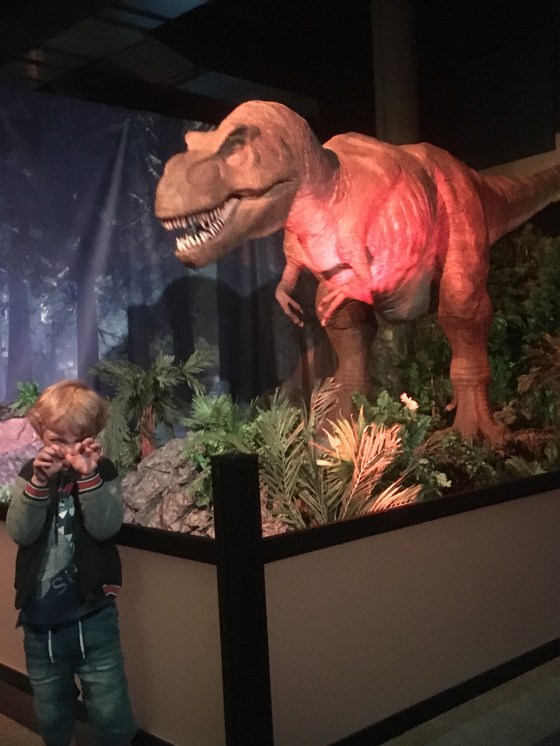
I tell him I’ll carry him and we’ll just stand at the door. The large room is dimly lit, dominated by huge, moving T-Rex and triceratops models, bright digital screens and echoing with dull, throaty roars.

We stand in the doorway for several more minutes. Eventually he peels his face off my neck and starts to ask questions. I take a few steps forward but quickly retreat as a roaring yellow-eyed T-Rex sends us back to square one. I keep reassuring him, we’ve come this far.

‘It’s ok buddy. It’s just like Andy’s Dinosaur Adventures.’

Soon I’m able to walk slowly through the exhibition as my son whispers the names of the various dinosaurs into my ear. The room doesn’t seem so dark now and the roars not so loud and aggressive, and he slips out of my arms, onto his feet. Now he’s leading me by the hand, standing closer to the models and studying their fierce expressions. Eventually he takes off, leaving me behind as he begins to race around the room.

Then he’s lost in a game of his own imagination, starring himself, Andy, a time-travelling clock and the dinosaurs. If I have a part in this performance, then it’s small and insignificant. An extra who stands at the back and doesn’t get involved.

He keeps running off, lost in his own sense of deepening joy, and making it increasingly difficult for me to watch him. As I search the dark corners I’m half expecting to see him on top of the T-Rex, astride it triumphantly like a modern-day Hannibal.

A few times I try to persuade him from the room but he won’t leave, he’s having too much fun. I tell him there are other things to play with but the Jurassic period is the only one which interests him now. Soon I’m yearning for an meteorite.

Eventually I drag him out and we play in the science room, but it’s merely filling time until he can go back to the dinosaurs. I tell him he can have one last play. As we get close to the door he takes off at speed, yelling ‘Dinosaurs, here I come!’

To bribe him into leaving quietly I offer to buy him a toy from the gift shop. He chooses the most fierce toy dinosaur in stock and emulates the roars and the savage expressions as we head back to the car.

He’s calm as we drive home, a little tired perhaps. At one point he reaches across and places his hand on my arm. We chat like grown-ups.

‘I had great fun today buddy.’

‘So did I daddy, it was brilliant.’

‘What was the best bit son?’

‘The dinosaurs were the best.’

‘The dinosaurs? Were they not a bit scary?’

‘No daddy, they’re not scary at all.’

2

Father’s Day

As a writer who often focuses on parenting issues, I sometimes get asked to sum up what being a father means to me.

I could use a recent memory as an example. Last week I picked my son James up from school, as I do every day. He’s in P1 and I have my working arrangements set up so I can spend the afternoons with him.

On this day I had to travel into Belfast for an appointment, and I had no option but to bring James with me. The problem was it was a swelteringly hot afternoon and not one that either of us really wanted to spend cooped up in the car.

I sold the venture by telling him I would buy an ice lolly and he could listen to whatever CD he wanted as we drove.

He looked at me, and without missing a beat, replied: ‘The Santa CD.’

I hesitated and shaded my eyes from the high and bright sun.

‘Are you sure buddy? It’s not very…..seasonal.’

But he would not budge. It had to be the Santa CD or the whole operation was off. I glanced nervously at my watch.

‘Let’s go then.’

Fifteen minutes later we were in gridlocked traffic on the Lisburn Road. As the sun baked the footpaths Belfast looked as close as it ever would to a proper cosmopolitan city. Shoppers browsed in the expensive little boutiques and workers in sunglasses sipped milky coffees as they lounged at outside tables.

And in the middle of it all a battered, old Seat inched along the road, windows down, with ‘Santa Claus is Coming To Town’ blaring at full volume.

Yes, we got some peculiar looks, but my wee man was happy as he listened and licked, his ice lolly melting and sending lines of sticky fruit juice up his forearms.

Then another song came on the CD. It was The Twelve Days of Christmas.

James immediately sat up.

‘Daddy, this is the one you like to sing along to.’

‘Yes buddy, but I’m not sure this is really the moment.’

‘Please daddy.’

I looked at him. He put on that face, the one that he knows will make me do whatever he wants. I nodded.

And so it was. On the hottest day of the year, in the middle of Belfast’s busiest street, hundreds of unfortunate pedestrians and passing motorists were treated to a hideously out of tune bellowing of ‘FIVE GOLD RINGS!!!!’

And I didn’t mind one bit because my wee man laughed and laughed.

I know it is Father’s Day this weekend. I’m sure James will have made something at school to give to me. I’ve no doubt my wife Debs will have arranged a surprise for him to present. And it will be lovely.

But, the truth is, everyday is Father’s Day for me. I’m the luckiest man in the world.

0

Thinking it thru

I was editing an article a few days back in a little trade magazine where I work sometimes.

A couple of minutes in I noticed the author had used the phrase ‘drive thru’. Automatically I changed it to ‘drive through’. I probably quietly sighed and rolled my eyes too. Soon, however, I realised that the more informal spelling had been used throughout the piece so I set about changing them all to what I believed to be the correct form. Then I noticed that the name of the business which was the subject of the feature also included the words ‘Drive Thru’.

At this point I started to pay attention. A quick Google search revealed that this business title did indeed include the word ‘Thru’. Taking the view that the proprietor has the right to name their own business as they please, I left it alone. But this created the inconsistency of having the term ‘Drive Thru’ as the business title but ‘drive through’ when I was describing it as a generic term. A little bit more Googling revealed that ‘drive thru’ is now commonly accepted as the preferred spelling for a drive through. One website described my assumed spelling of ‘drive through’ as ‘anachronistic’.

I sat back. In truth I was a little shocked. How had this happened? I had that peculiar stirring in my brain which occurs occasionally when something which has been obvious to the rest of society for years becomes apparent to me.

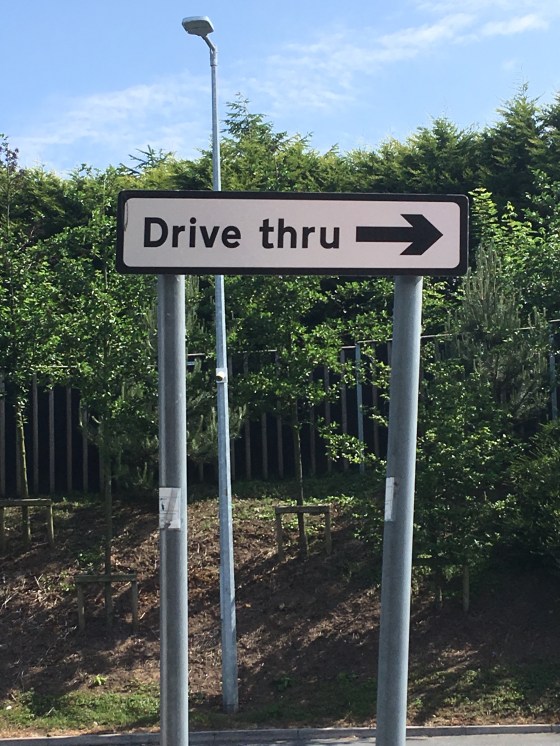
I don’t have cause to write the phrase ‘drive through’ (thru) very often, but now I started to think about it. I began seeing ‘drive thru’ appearing often in print and communications. I actually noticed it on road signs directing people towards fast food restaurants. Yet people seemed to be walking past the signs without any apparent care or concern. There were no flaming torches or protestors with cans of spray paint filling in the missing letters.

And those whom I stopped to point out the disparity seemed to think there was more peculiarity in my approach than the lettering on the signs.

I even had an awkward encounter when one business owner asked me why I was taking photographs of his sign. My explanation that I was spending my day researching the evolving spelling of ‘through’ seemed neither to convince or satisfy.

How had it come to this? My first thought was that it must be an American influence. The concept of the drive through restaurant originates there and the spreading influence of US spelling on this side of the Atlantic is well documented. But when I checked US spelling lists it was clear that the accepted spelling there is ‘through’, not ‘thru’.

This led me to phone an American friend. When I put my query to him he very gallantly didn’t say ‘What the hell’s wrong with you? Why don’t you go and get a proper job and do something useful with your life?’ Instead he patiently explained that ‘thru’ was a deliberate misspelling created by US sign writers to save space. Much in the same way that they might use ‘nite’ instead of ‘night’.

And now it’s here, on our signs. Or rather, it’s presumably been here for ages but I’ve only just noticed it.

So I have my answer. We have moved into an time where ‘drive thru’ exists independently and separately from through. Sort of like an embarrassing distant cousin that you only see at weddings, who always gets drunk and tries it on with the bridesmaids.

But it doesn’t end there, because language always evolves. ‘Thru’ is now regularly used in text and electronic communications and seems to have gained traction as an accepted informal usage. I may be one of the last people who still spells out ‘through’ when texting (although admittedly my average time to send a single text is roughly fifteen minutes). It’s reasonable to assume that there will come a point in the distant future where ‘thru’ is the only accepted spelling and to write ‘through’ would be as obscure as scratching out ‘the lyf so short, the craft so longe to lerne’ with a quill.

And does it really matter anyway? Not massively, as long as the meaning is clear and the opportunities for confusion and inconsistency are kept to a minimum. Whichever way we spell ‘through’ the planets will still circle the sun, petrol prices will rise and whales will be found dead with their stomachs full of plastic bags.

Although I’m currently helping my young son to learn to read. He gets a list of words sent home every week to memorise. It presumably won’t be very long until ‘through’ is among them. It’s already a tricky one because, according to the phonic system which the school curriculum favours, ‘through’ should really be spelled ‘thrue’ or ‘throo’. I’ll already have to teach him that this is one of those annoying words which just can’t be sounded out. Add in the extra confusion that he now regularly points at signs and asks me what they say (‘Well son, it says ‘thru’ but if you spell it that way at school you’ll be marked wrong, until the point when the people who decide the curriculum accept it as the proper spelling, then you’ll be marked right. And, by the way, threw is a completely different word, so don’t mix them up. Any more questions?’)

It’s a complicated business and I’m not sure I’m any further forward. I’m still a little dissatisfied and confused today as I finish my edit of the article and place it on the page. But I force myself to put it out of my mind. I’m thru with it.

0

The nuisance phone calls

A year ago I switched my electricity supplier. A rival company was offering a deal with cheaper prices, so I moved over.

Then a couple of weeks back my original supplier phoned me to inform that the deal which had lured me away had now expired and their prices were once again cheaper. So I moved back.

Then a couple of days ago I was phoned again by the rival supplier. They had obviously got wind of my intended treachery and wanted to turn my head by reading me long lists of unit prices. I was doing homework with my son at the time, and in truth getting a bit fed up with this, so I told them to call me another time.

Which they have done. Again and again and again. I now recognise the number and avoid answering, fearful that I’ll crumble once again and end up stuck like a ping pong ball being bounced back and forward between these two energy corporations for the rest of my life.

I don’t receive many personal or business phone calls (almost all of my genuine communication is done by message, email, smoke signal or carrier pigeon) so I have a fair idea that when my phone rings it will be an unwanted call and, very often, of dubious origin.

The numbers are usually English, but sometimes from abroad. Often I don’t answer. But this leaves me in a state of uncertainty, that little nagging doubt in the back of my mind. What if it is a genuine useful call? I wouldn’t want to miss that message from the producers of Strictly Come Dancing, checking on my availability for the next series (‘McCambridge didn’t answer, see if you can get The Krankees instead’).

If I do answer the caller invariably cannot pronounce my name (‘Is that Mr McCaaaambreeedge?’).

They often start by asking me to confirm a personal detail, which I refuse to do.

Sometimes they start by telling me that they have reason to believe I’m eligible for PPI compensation, a dishonest way of making me think they have already done some research of my case.

Other times they ask me if I’ve been involved in an accident (‘not until this very moment’).

But most of the time I never let the conversation get that far, hanging up before any level of personal connection can be established.

Then they leave it half an hour, and try me again.

I’ve had scam calls from Tunisia, where the caller dials your number but hangs up before you can answer. The idea is that you see the missed call and phone back. If you do, the call will cost you a fortune.

On one occasion a caller asked me what sort of phone I was using. The question wrong-footed me and I had to answer honestly that I wasn’t sure. There was a moment of silence before he called me a ‘dickhead’ and hung up.

Another day I answered more quickly than the caller expected and heard her saying to a colleague ‘Christ, I’m going to need a large drink when this day is finished’ before snapping on her corporate voice as soon as she realised I was on the line.

On a couple of occasions I’ve told the caller to ‘hold the line’, left the phone beside the bed and then gone off to have a bath, just to see how long they’ll hang on for.

The calls seem to come in bands. For a few weeks I’ll receive none at all and then several in a single day. I imagine my number is on a database somewhere and, quite possibly, my photo is pinned to the wall of a sweatshop somewhere, under the heading ‘Soft Touch’.

Recently I’ve noticed occasions where I’ve not answered a call from an unknown landline number, only to receive a call seconds later from a mobile.

I really don’t want to be rude to these callers (it must be a terribly difficult and demoralising way to make a living), but the sheer persistence and inanity of the contacts is bringing out the worst in me. It also puts me on edge every time my phone rings, which is not how I want to be. I know there are some genuine calls out there, but it’s getting evermore difficult to weed them out from all of the rotten ones.

I suppose what I’m trying to say is, for God’s sake, just leave me alone.

0

D is for duh

A note was sent home in my son’s schoolbag today.

It advised that teachers will be finalising their assessment of the children’s ‘phonic knowledge’ over the next week and asked parents to revise the sounds the kids have been learning throughout the year.

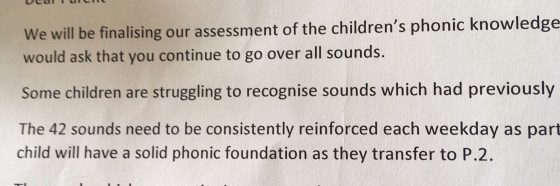
With no little menace one line in the note stated baldly: ‘Some children are struggling to recognise sounds which had previously been identified.’

It went on to advise that the ’42 sounds need to be consistently reinforced each weekday as part of homework’. This will lead them towards having a ‘solid phonic foundation’.

For the uninitiated this may sound like a terribly complicated and woolly business. In reality it’s teaching P1 children to read.

And more specifically it’s about implementing the ‘Jolly Phonics’ system as a method of easing that process.

Phonics is a method of reading where children learn by sounding words out. B is not ‘b’ but rather ‘buh’, L is not ‘l’ but ‘luh’ and so on. There are also accompanying actions, images and songs for each sound. My son has been learning it with mixed results for the past six months or so.

Up to now I’ve avoided passing any comment on phonics for a couple of reasons.

First because I don’t think there is any one universal system which works for all when learning children to read. Phonics may work well for some kids, whole word reading or using memory will be better for others.

The second reason is that I wasn’t entirely sure my wee man was ready for it at the start. He’s young in his class and didn’t seem to get the gist straightaway. Now, as he comes to near the end of P1 he’s maturing quickly and picking up techniques and methods with more success. It seemed fair to wait.

So this afternoon we sat down for a study session ahead of the assessment.

The consonant sounds were fine, he recognised them all without hesitation and was able to give examples of words with each one. He was even able to identify most of the vowel sounds successfully.

It was when we moved on to the single sounds which use double vowels that things started to get tricky. For him and me. Ai was tricky, as was ie and ou. Luckily I had downloaded the Jolly Phonics app onto my phone and had to refer to it several times when I struggled to identify the sounds I was supposed to be teaching him.

At times it seemed like the system had been devised by a sadistic pedant. The logic of trying to explain to a five-year-old that the oo sound in ‘book’ is an entirely different phonic than the oo in ‘too’ was utterly lost on me.

My son tried hard but after a while I could see he was becoming tired and restless. I was struggling also so I decided to call a halt. We’ll have another go tomorrow.

I’m not certain that I’ve managed to ‘consistently reinforce all 42 sounds each weekday’ as dictated by the school’s note, but there you go.

I’m not sure how my son will fare in his assessment. But I’m not too bothered.

He has always loved books and reading, his speech and vocabulary have always been splendid and his imagination works without bounds. I have no doubt whatsoever that he’ll be perfectly literate, with or without the help of Jolly Phonics.

The point that the system seems to be missing, in my opinion at least, is that much of this knowledge about sounds is intuitive. Kids often know things before they can explain what they know. I stopped today because I was getting the strong sense that the only thing I was achieving was confusing my son. Education is so much wider than being able to point out the difference to the ear between er and ar. It’s just too bloody abstract and, at times, without logic.

I’ve worked as a writer all of my adult life. I also do occasional public speaking. I’ve even learnt a form of written communication which is entirely based on phonics – it’s called shorthand.

But, in truth, I struggle to find a clear path between good written or verbal communication and the system they are being taught. The process is immediately undermined by the lists of words which are sent home in my boy’s schoolbag every week to be memorised. We are told they are special cases which are to be learnt by sight and not by sounding.

I don’t want to be overly critical because, as I said earlier, I’ve no doubt that phonics has its place as an aid to literacy, just as learning by context, meaning and illustration do as well. But the curriculum currently favours phonics. The debate over the best way to do this has been going on for decades and will continue for many more.

In the meantime my wife and I will continue to cuddle up with our son and a book in bed every evening, we’ll point at the words and he’ll tell us what they are. I don’t know about his solid phonic foundation, but along the way he’ll certainly learn to read.